Stone circles and burial monuments mark a landscape used for thousands of years.
The history of Fronlwyd
A house in an ancient valley
The surviving cruck roof at Fronlwyd has been dated to around four hundred years ago. The valley’s story reaches much further back, although those earlier sites belong to the wider landscape rather than to the house itself.
I started looking into the house because I wanted to know who had lived here before us. It has rather got away from me. What began with learning about the cruck roof and a dated floorboard soon led to an ancient crossing, woollen cloth, reformers, transported thieves and families leaving for lives on the other side of the world. Along the way I kept finding much older stories in the surrounding landscape too.

Long before the house
A landscape already full of stories
People had been living, farming and burying their dead in these hills thousands of years before Fronlwyd was built.
When I began looking into Fronlwyd, these much older places kept appearing in the records. Above and around Llanbrynmair are prehistoric burial cairns and ceremonial monuments on the high ground overlooking routes through the valleys. They were here thousands of years before the house. The sites include the stone circles at Cerrig Caerau and Lled Croen yr Ych. Yr Allor, a nearby ring cairn, was opened in about 1860 and a stone-lined grave with human remains was reportedly found inside.
These are protected archaeological sites rather than places to climb over, but knowing they are there changes the way the hills feel. The valley was not empty wilderness waiting for history to begin. It had already been known, worked and remembered for generations beyond counting.
What we know, and what we do not: these monuments are wider landscape context only. There is no known archaeological connection between them and Fronlwyd. The surviving cruck roof at the house is roughly four hundred years old; the hilltop monuments are thousands of years older. I include them because they help explain the landscape around us, not because they belong to the history of the house.


A face from the past
The carved head
In 1971, a water-rolled pebble carved in low relief with a human face was found face down in the bed of the River Twymyn, immediately above the bridge at Bont Dolgadfan. I had wondered where it had gone, and was delighted to discover that it had not disappeared at all.
Amgueddfa Cymru – Museum Wales catalogues it as an “Iron Age stone head”, but also notes that the identification has not been verified. Without a secure archaeological setting it is difficult to date with confidence, so the mystery remains, but at least we now know where the face is being looked after.
Where it is now
In the national collection
The head was donated in 1972 and is now in the national collection cared for by Amgueddfa Cymru – Museum Wales. Its catalogue record currently gives its location as “In store”, so it may not be on public display. You can see the museum’s full record here.
Romans, saints and princes
Routes through the hills
The Romans were certainly active in the wider Llanbrynmair district. A second-century fortlet at Penycrocbren may have watched over mineral workings, and a Roman road ran west from Caersws through this country, although its precise course remains debated.
Later, the old church at Llan became a focus for the community. St Mary’s is traditionally said to have sixth-century origins. That early date cannot be proved, but the church contains a thirteenth-century font and surviving medieval fabric.
Domen Fawr, the motte at Llan, belongs to a landscape contested by Welsh princes and Norman power. In 1149 the area was granted to Owain Cyfeiliog, and land later came within the reach of Strata Marcella Abbey.
The Black Death reached Wales in 1349. We do not have a record telling us exactly what happened in Bont Dolgadfan, but communities across medieval Wales lost people, labour and continuity. A few generations later, in 1404, Owain Glyndŵr held his parliament at Machynlleth.
These events give the valley its wider setting. There is no evidence that Roman soldiers marched past the present house or that Glyndŵr visited this exact spot, tempting though those stories would be.


The name and the bridge
Cadfan’s meadow
The name Dolgadfan appears in written records by 1573 and probably means Cadfan’s meadow or river flat. The village grew around the crossing of the Afon Twymyn, with the bridge documented in the seventeenth century and substantially rebuilt in 1748 at an estimated cost of £80.
Before modern roads, this was part of the route linking Machynlleth with Newtown and Welshpool. Livestock, wool, traders, letters and news all moved through this narrow valley. Fronlwyd was not isolated from the world. The world passed below it.
The house takes shape
Four hundred years at Fronlwyd
The oldest surviving part of Fronlwyd is its traditional Welsh cruck roof, dated to around four hundred years ago. Its great curved timbers rise from low in the walls and can be seen on the 1st floor, at some point the roof was raised enabling it to be seen in the stables side guests bedroom, carrying a structure that has survived centuries of weather, work and alteration.
A Welsh longhouse was a practical farmhouse built as one long range. The family lived at one end and livestock were kept in a separate byre at the other, beneath the same continuous roofline. It did not mean everyone shared one room with the cattle. It brought home and farm together in a building shaped by rural Welsh life.
At Fronlwyd, thick walls, flagstones, an inglenook fireplace and bread oven survive, while one part of the range appears to have housed livestock. The arrangement makes much more sense once you understand that Fronlwyd was not simply a cottage but a working Welsh longhouse.
A floorboard dated to the 1740s gives us one later moment in the building’s life. It is not the date of the cruck roof. The house was not built as a museum piece; it grew and changed as generations needed it to, and that is part of why it still feels alive.
On 6 July 1801 an order was made for a new turnpike road through the area, replacing part of the old highway while preserving access to Fronlwyd. The road below the house still traces that shift in the valley.
The tithe records of 1839 to 1841 name David Thomas as the occupier, with the estate owned by Sir Watkin Williams Wynn. One field was called Cae tan y tŷ, the field below the house. By 1875 Hugh Francis of Fronlwyd appears among the Wynnstay tenants attending a large estate banquet.
What the building tells us
A house made to keep going
Fronlwyd was never meant to be frozen at one perfect moment. It was a working home. Floors wore, roofs were repaired, rooms changed purpose and families made it fit the life they had.
We feel part of that same long process now. We are looking after an old house, not finishing its story.
Wool, water and work
The village factory
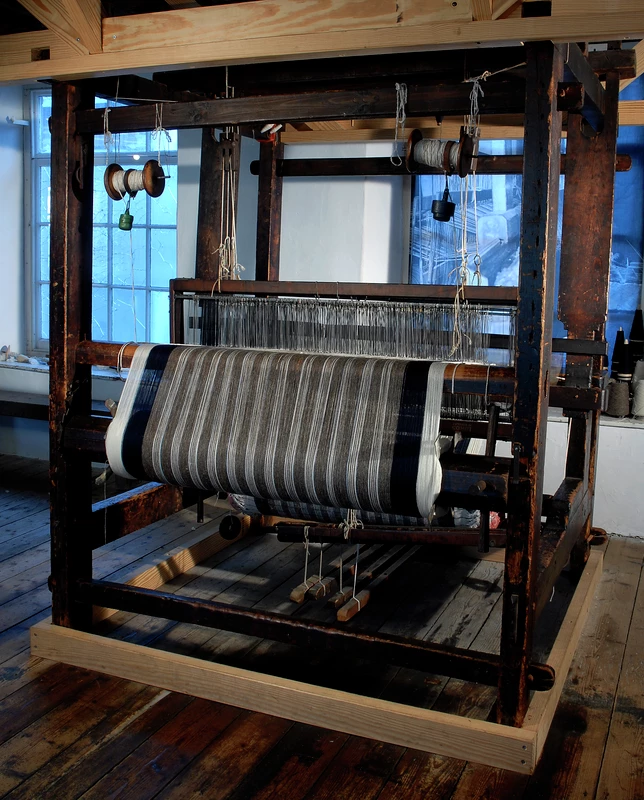
Farming was only part of the local economy. Wool was spun and woven in homes throughout this part of Montgomeryshire. Woven cloth could be washed and beaten in a water-powered fulling mill, a pandy, to clean, thicken and finish it.
The mill south of Bont was known at different times as Gellidywyll, Felin Dolgadfan, Pandy Dolgadfan and Pandy Isaf. The Howell family was associated with it from at least 1744 until the late nineteenth century. It began as a pandy and was later converted to grind corn.
Around 1800 John Howell built a factory at Bont Dolgadfan. The village produced flannel and a rough cloth remembered as crimsi. Family letters mention wool purchases, tight finances, a poor harvest and bad conditions in the flannel trade. Others wrote from America about wages, prices and prospects there.

Wool from the hills, water from the river and long hours of skilled work connected this small village to a much wider world.
The difficult wider story of Welsh cloth
This is the part of the story I did not expect to find, and it is not comfortable. Alongside Montgomeryshire flannel, mills in mid Wales produced a coarse cloth known as Welsh plains, or locally as webs. British merchants and enslavers traded this cloth in West Africa, and it was also used to clothe enslaved people on plantations in the Americas and West Indies.
The Machynlleth and Vale of Dyfi was one of the districts known for making it, so our part of Wales was involved in that wider economy. Researchers are also careful to say that not every fulling mill made Welsh plains and that it is often impossible to identify exactly which mills did. I have not found evidence proving that cloth from Bont Dolgadfan itself entered the trade, and I do not want to claim more than the records tell us.
Local letters describe tight finances, poor harvests and hard times in the flannel trade. That hardship matters, but it does not erase the fact that Welsh cloth was woven into a system built on enslavement. Both truths belong here.
You can read more in the Royal Commission’s research into Welsh wool, slavery and the built environment and the National Wool Museum’s Perspective(s) project.
One of our own discoveries
The drying kiln
We had driven past this little stone building countless times and always wondered what it was. It is easy to miss beside the road near Plas Llwyn Owen, but once we found out, another piece of the valley suddenly made sense.
It is a rare nineteenth-century drying kiln, probably linked with Gellidywyll Mill. A fire burned below a perforated floor, allowing warm air to rise and dry grain, and perhaps timber too. The firebox and part of the drying floor still survive.
This is one of the things I love about looking into the history here. Something you have passed for years stops being just an odd little building and becomes part of the story.

A valley of strong opinions
Samuel Roberts and the urge to change things
Samuel Roberts was born at Llanbrynmair in 1800 and became an Independent minister, writer, editor, farmer and tireless campaigner. He wrote about slavery, education, free trade, postal reform, political rights and the treatment of tenant farmers.
His politics were not abstract. At Diosg Farm his father had reportedly spent £700 improving the holding, only for the rent to be doubled. Roberts understood how power could reach into an ordinary family’s home and livelihood.
In 1830 he published Cwynion Yamba, y Gaethes Ddu, giving a voice to an enslaved Black woman as part of his anti-slavery writing. His later years in America were more complicated. His absolute pacifism led him to oppose the Civil War even while slavery endured. He was not a slaveholder, but that position remains an uncomfortable part of his legacy.
I have not found evidence that Roberts wrote specifically about Fronlwyd. He belongs here because his family, chapel, arguments and ambitions grew from this same small community.
Books, hymns and debate
A small place with a busy mind
The chapels were not only places of worship. They supported literacy, music, debate, mutual aid and politics. Bont Dolgadfan had an agricultural-school library, a friendly society, temperance meetings, eisteddfodau and both Welsh and English congregations.
William Williams, known as Gwilym Cyfeiliog, acquired property and a flannel mill here around 1822. He was a shopkeeper, poet, hymn writer and public servant, another example of the way commerce, culture and public life overlapped in the valley.
His daughter Sarah kept an album between 1872 and 1901 with contributions from about 123 people. It is a lovely reminder that rural life was not narrow or silent. Ideas, friendships and family connections travelled far beyond the hills.
Letters across the ocean
Leaving the valley
In 1848 Samuel Roberts wrote that more than thirty-five people locally were preparing to leave for America. Families from this part of Wales settled in places including Ohio, Pennsylvania and Iowa, while letters home compared wages, prices, land and opportunity.
Roberts himself travelled to Tennessee in 1857 to establish a Welsh settlement called Brynffynnon. Land dealing, hardship and then the Civil War brought the plan to an end.
I do not yet know whether anyone living at Fronlwyd joined those departures. It is one of the questions still waiting in the records. What is certain is that migration was part of life here. People left these hills for new homes, and their descendants are now scattered far beyond Wales.
That feels especially poignant when guests arrive from Australia, America or elsewhere and begin talking about their own Welsh family connections. Sometimes the distance between this valley and the wider world suddenly feels very small.
The research continues
Every answer produces another question
Who built the earliest part of Fronlwyd? Who carved the stone face? Did anyone leave this house for America or Australia? What did ordinary days here look like during the two world wars?
There is still a great deal I would like to find.
Dolgadfan appears in the surviving written record.
The surviving cruck roof at Fronlwyd dates from around this period.
A dated floorboard records one moment in Fronlwyd’s changing fabric.
The bridge at Bont Dolgadfan is substantially rebuilt.
John Howell builds a cloth factory in the village.
A new turnpike road is ordered through the valley.
The tithe records name David Thomas as occupier of Fronlwyd.
More than thirty-five local people are said to be preparing to leave for America.
For now, not the final word
A story we are still piecing together
I started this research because I wanted to know who had lived at Fronlwyd before us. So far we have found far more than I expected, and every answer seems to produce another question.
If you know a family story, have an old photograph or spot something I have misunderstood, please tell me. This page is not meant to be the final word. It is the story as we understand it now, and I would love to keep adding to it.
Where the story came from
Archives and further reading
The page draws on archive catalogues, historic maps, archaeological records, biographies, local histories and family correspondence. Where the evidence is uncertain, I have tried to say so.
Amgueddfa Cymru: the Bont Dolgadfan carved head
Royal Commission: Welsh wool, slavery and the built environment
National Wool Museum: Perspective(s)
Powys Archives
Tithe Maps of Wales
Coflein, the National Monuments Record of Wales
Heneb: Llanbrynmair historic landscape
Dictionary of Welsh Biography
The National Library of Wales
People’s Collection Wales
The Modern Antiquarian
Come and see the valley
Stay somewhere with a story
Fronlwyd is still a home, still changing and still looking out across the same quiet Mid Wales landscape.
Explore our stays